Best Baby Nasal Aspirator: Electric vs Manual Comparison from the creator of Nosiboo (2026 Guide)
When your baby has a blocked nose, everything becomes harder—feeding, sleeping, even breathing. As a parent, you want a solution that is not only effective but also safe, gentle, and easy to use.
But with so many options on the market, one question keeps coming up:
👉 Which baby nasal aspirator is actually the best?
In this guide, we’ll break down the key differences between the most popular types and brands— so you can confidently choose what works best for your baby and your daily routine.
Quick Answer: What Is the Best Nasal Aspirator for Babies?
There is no single “best” nasal aspirator for every family.
Instead, the right choice depends on:
- your baby’s congestion type
- your lifestyle (home vs travel)
- how much control and convenience you need
👉 Electric nasal aspirators are generally best for:
- thick or stubborn mucus
- frequent daily use
- parents who want consistent performance
👉 Manual nasal aspirators are best for:
- travel and quick situations
- full control over suction
- simple, lightweight solutions
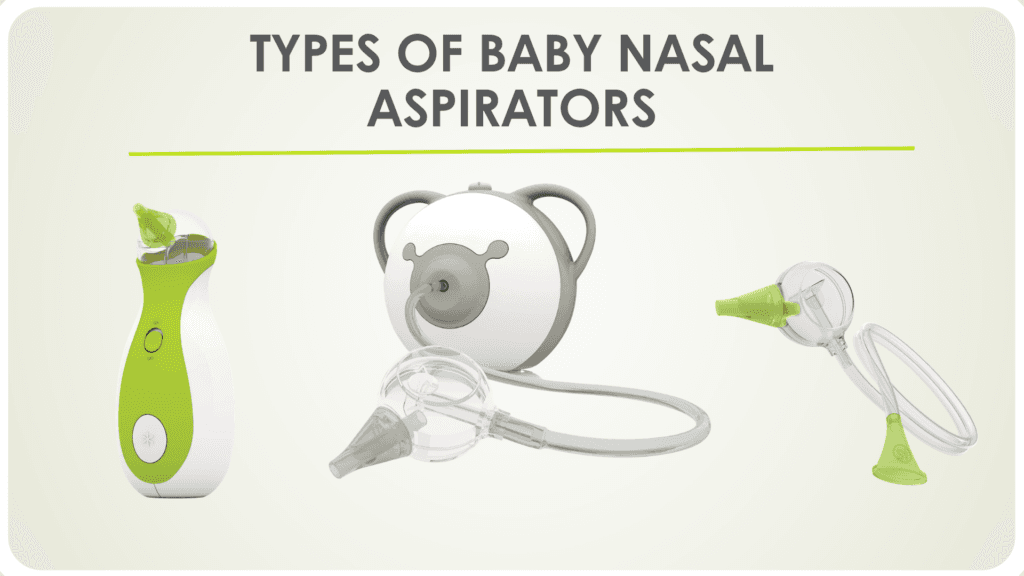
Types of Baby Nasal Aspirators Explained
Electric Nasal Aspirators
Electric models use a motor to create suction.
Key advantages:
- consistent suction power
- one-handed operation
- less physical effort
Best for:
Busy parents, frequent congestion, nighttime use
Manual Nasal Aspirators
Manual aspirators rely on the parent’s suction.
Key advantages:
- full control over strength
- silent operation
- portable and simple
Best for:
Travel, occasional use, budget-conscious families
Side-by-Side Comparison of Popular Nasal Aspirators
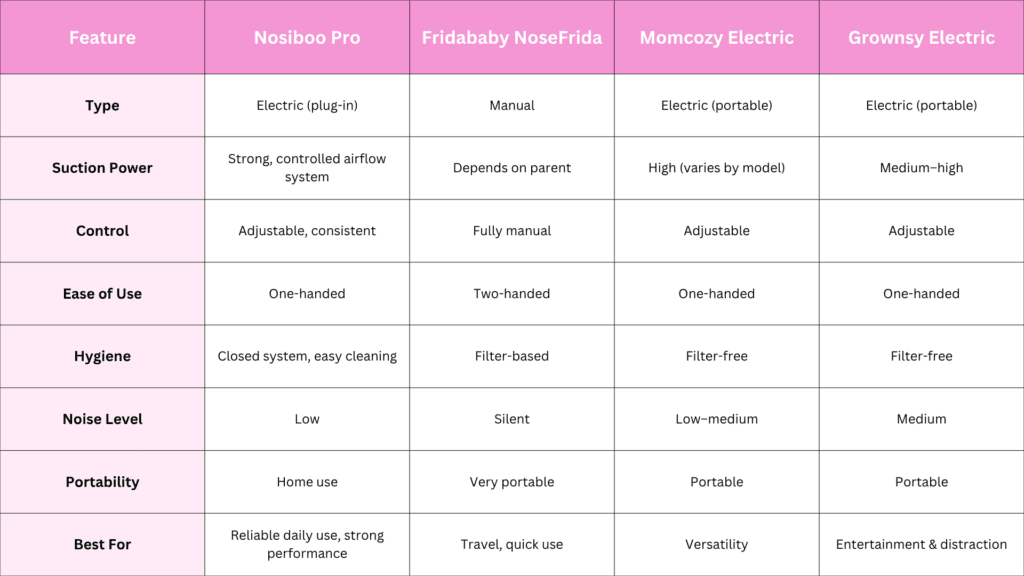
What Really Matters When Choosing a Nasal Aspirator
1. Suction Power (And How It’s Delivered)
Not all suction is created equal—and this is one of the biggest differences between nasal aspirators.
Manual devices rely entirely on the parent’s lung power, which can vary from moment to moment. Electric devices, on the other hand, provide more consistent suction—but even here, the way suction is delivered matters just as much as the raw power itself.
Some devices focus purely on high kPa numbers, but strong suction alone is not enough. If the airflow is not properly controlled, it can feel uncomfortable for the baby or be less effective at actually removing mucus.
This is where more advanced systems come into play. For example, solutions like the Nosiboo Pro are designed around a controlled airflow principle, meaning the suction is not only strong but also gentle and predictable. Instead of “pulling aggressively,” it creates a steady, safe airflow that helps remove mucus effectively without causing discomfort.
👉 This becomes especially important when dealing with thick, dried mucus, where both strength and control are required—not just one or the other.
2. Hygiene and Cleaning
Hygiene is one of the most critical—but often underestimated—factors when choosing a nasal aspirator.
After each use, you are dealing with mucus, bacteria, and moisture. If the device is difficult to clean or allows contamination to travel through internal parts, it can quickly become a source of stress rather than relief.
Some manual systems require disposable filters, which need to be replaced regularly. While this can help with hygiene, it also adds ongoing cost and dependency on extra components. Other electric devices may be filter-free but still require careful cleaning, especially if mucus can reach deeper parts of the device.
This is where design makes a real difference. Devices like Nosiboo are built with a closed, hygienic system, where mucus is collected in a way that prevents it from entering the tube or motor. The detachable parts can be easily rinsed, making cleaning simple and quick—even during stressful moments.
👉 For parents, this means less worry about hygiene and more confidence that the device is safe to use again and again.
3. Ease of Use (Especially at 3 AM)
At 3 AM, when your baby is crying and struggling to breathe, usability becomes more important than any feature list.
You don’t want to think about instructions, multiple steps, or complicated handling. You need something that works immediately, with minimal effort.
Manual aspirators often require two hands—one to position the tube and one to create suction—which can be challenging when you’re also trying to hold and comfort your baby. Many electric models improve on this by offering one-handed operation, but the simplicity of controls still varies significantly.
Well-designed devices focus on reducing friction in these stressful moments. For example, Nosiboo Pro is built for intuitive, one-handed use, with simple controls that allow you to focus on your baby rather than the device.
👉 The real question is not “how many features does it have,” but “can I use it easily when I’m tired, stressed, and in a hurry?”
4. Noise Level
Noise can make or break the experience—for both baby and parent.
Manual aspirators are completely silent, which can be helpful during naps or nighttime use. Electric devices introduce motor noise, which varies depending on the model and quality.
Some devices try to compensate with music or lights, but for many babies, sudden or unfamiliar sounds can still be unsettling.
That’s why a balanced approach matters. A well-designed electric aspirator should be quiet enough not to startle the baby, while still delivering effective performance.
Devices like Nosiboo Pro are engineered to operate at a low, steady noise level, avoiding sudden or sharp sounds that could cause distress.
👉 In practice, this means a smoother experience—especially during nighttime use, when every extra disturbance matters.
5. Long-Term Value
At first glance, some options may seem more affordable—but the real cost often becomes clear over time.
Manual aspirators typically have a lower upfront price, but require ongoing purchases like disposable filters. Over months or years, these small costs can add up significantly.
Electric aspirators usually involve a higher initial investment, but many are designed to work without recurring costs, making them more predictable in the long run.
Beyond cost, durability also plays a key role. A product that is used frequently needs to be reliable, consistent, and built to last.
This is where premium solutions stand out. Products like Nosiboo are designed for long-term daily use, combining durability, consistent performance, and minimal maintenance requirements.
👉 When you look at total value—not just price—the most effective solution is often the one that works reliably every time, without adding extra steps or hidden costs.
What is the best nasal aspirator for babies?
The best nasal aspirator depends on your needs, but most parents prefer electric models for their consistency and ease of use.
Electric aspirators provide stable suction and require less effort, making them ideal for frequent use. More advanced solutions—such as those using controlled airflow systems like Nosiboo—combine effectiveness with gentle operation, which is especially important for babies.
👉 In general, the best choice is a device that is effective, easy to clean, and comfortable for your child.

Is an electric or manual nasal aspirator better?
Both have advantages, but they serve different purposes.
- Manual aspirators offer full control and are highly portable
- Electric aspirators provide consistent suction and are easier to use
For daily use, especially during illness, many parents find electric aspirators more practical. Devices like Nosiboo are designed to reduce effort while maintaining controlled, safe suction.
👉 A common solution is using an electric device at home and a manual one for travel.
Are electric nasal aspirators safe for newborns?
Yes, electric nasal aspirators are safe for newborns when they are designed specifically for infants and allow adjustable suction levels.
The key is controlled suction, not just strong suction. Systems that regulate airflow—like Nosiboo—help ensure that the process remains gentle and predictable.
👉 Always start with the lowest setting and adjust based on your baby’s comfort.
How do you use a nasal aspirator correctly?
To use a nasal aspirator effectively:
- If needed, apply saline solution to loosen mucus
- Place the tip gently at the entrance of the nostril
- Apply suction slowly and steadily
- Clean the device after use
Electric aspirators simplify this process, especially when designed for one-handed use. This is particularly helpful when handling a moving or uncomfortable baby.
Do you need saline solution before using a nasal aspirator?
In many cases, yes—especially if the mucus is thick or dry.
Saline helps soften the mucus, making it easier to remove. Some modern devices combine these steps, while others require a separate spray.
👉 Even with advanced aspirators, pre-softening can improve effectiveness and comfort.
What suction power is ideal for a baby nasal aspirator?
For light congestion, moderate suction is sufficient.
For thicker mucus, stronger suction is needed—but control is just as important as power.
High numbers alone don’t guarantee better performance. A well-designed system should deliver stable, controlled airflow, rather than sudden or harsh suction.
👉 This is why many parents prioritize reliability and comfort over raw power alone.
How do you clean a nasal aspirator?
A nasal aspirator should be cleaned after every use.
Most modern devices are designed with removable parts that can be rinsed with water. Some systems require filter replacement, while others use filter-free designs.
Devices with a closed system, like Nosiboo, prevent mucus from entering internal parts, making cleaning faster and more hygienic.
👉 Easy cleaning is essential for safe and regular use.
Can using a nasal aspirator hurt my baby?
When used correctly, nasal aspirators should not hurt your baby.
The key factors are:
- gentle positioning
- controlled suction
- using age-appropriate tips
Babies may resist the process, but that does not mean it is painful—just unfamiliar.
👉 Choosing a device designed for comfort, with controlled suction, can significantly improve the experience.
Why doesn’t a nasal aspirator always work?
There are several common reasons:
- mucus is too dry (needs saline first)
- suction is not strong or consistent enough
- incorrect positioning
- baby is moving or resisting
In many cases, switching to a more reliable or consistent system can improve results. Electric aspirators are often preferred when manual solutions become tiring or ineffective.
Is a nasal aspirator necessary for babies?
While not always mandatory, nasal aspirators can significantly improve comfort for babies with congestion.
Since babies cannot blow their nose, removing mucus helps:
- improve breathing
- support feeding
- improve sleep
👉 For many parents, a nasal aspirator quickly becomes an essential part of daily care during cold or allergy seasons.